
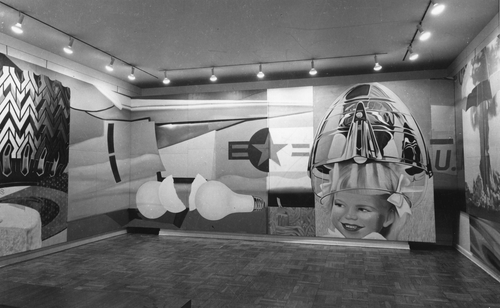
Installation view, James Rosenquist: F-111, Leo Castelli Gallery, 4 EAST 77, 1965
© James Rosenquist Foundation Used by permission. All rights reserved.
In April 1961, Robert Scull stopped to stare at a Bonwit Teller & Co window display fronting Fifth Avenue. Behind the mannequins modeling soigné fashions were five huge paintings. One flaunted "before" and "after" nose job profiles, another, Superman's heroics. Scull, a forty-four-year-old taxi magnate and prophetic art collector, was already aware of Andy Warhol, although the artist had yet to attract gallery representation. Within two years, Scull would give Warhol his first portrait commission, the iconic Ethel Scull 36 Times, now in the Whitney Museum.
As the sixties began, Bob Scull was one of the rare collectors interested in young American artists. Jasper Johns’ 1958 debut at the Castelli Gallery ignited his impassioned interest in the artist, an attentiveness that never slackened. In 1959, art dealer Ivan Karp sold Scull one of John Chamberlain's earliest scrap metal sculptures. His ensuing patronage enabled Chamberlain to quit cutting hair for a living and concentrate on his art. In Karp's experience, Scull was a man on the prowl for "really aggressive new art"[i]. Never self-effacing about his second sight, he boasted: "I really and truly don't trust other people's intuitions. I only trust my own" [ii].
Henry Geldzahler, the Metropolitan Museum's first curator of contemporary art, remembered that when Scull began to buy Pop art, "he couldn't have gotten advice from anybody because nobody else was doing it" [iii]. Not known for being wordy, Warhol credited Scull for "pull[ing] off what everyone who collects dreams of— he built the best collection by recognizing quality before anybody else was on to it" [iv].
Born and raised in the impoverished community of Russian-Jewish immigrants on New York's Lower East Side, Bob Scull first visited the Metropolitan Museum in 1927. It proved a revelatory experience for the ten-year-old. "I thought [art] was one of the better things in life... that it would be uplifting to know about art" [v]. As an empty-pocketed, aspiring artist in 1944, he married Ethel Redner, whose wealthy father eased his entry into the taxi business. With this change of fortune, Scull's inchoate desire fueled his emergence as a cultural bellwether.
He became the energetic eye driving the couple's purchases when they began collecting art in the mid-fifties. At first, they bought Renaissance bronzes but backed away when prices turned dear. Wide-ranging acquisitions of post-WW II art followed, to be supplanted by American abstract expressionists. After losing interest in artists vetted before he became aware of them, art of the present moment became his abiding passion.
Commenting about his own prowess as a scout, Scull half joked: "I crawl into more lofts than fire inspectors— and when they're good, I pay 'em a living wage" [vi]. Not an idle boast, his patronage proved crucial for several careers. Nonetheless, the self-congratulatory quip obscures his recurring reliance on eagle-eyed dealers, such as Leo Castelli and Richard Bellamy. From 1961-64, Bob Scull covertly backed the short-lived Green Gallery on Fifty-Seventh Street, directed by Bellamy, later nicknamed "the Eye of the Sixties" [vii]. Responding to a heads-up from Bellamy in 1961, Scull visited James Rosenquist’s studio, becoming the first collector to purchase his radical new work. Scull made a more fearless acquisition four years later, at the artist’s debut at the Castelli Gallery.
As the Vietnam War intensified in 1964-5, Rosenquist worked on a monumental compilation of disjointed images that reflected his ardent antiwar feelings [viii]. Today in the collection of the Museum of Modern Art, F-111 is an 85-foot-long, 51-panel painting that Castelli displayed across three gallery walls. He’d expected to sell the fragments separately, but few had found buyers when Scull dashed in to see the show just before it was taken down. He bought them all [ix]. Sixty thousand was the asking price,” Rosenquist remembered, “but Scull paid $45,000,” (with a discount). “It was a very brave thing for Scull to do. He almost deserved to have it for nothing" [x].
Did the Sculls channel the sixties zeitgeist or help to shape it? To untangle an answer is like trying to know the dancer from the dance. The country’s first celebrity collectors, they were spotlit for their vanguard art and for Ethel’s couturier wardrobe and social panache. Thomas Hoving, a former director of the Metropolitan Museum remembered them as “the ultimate 1960s New York nouveau-riche, social-climbing art couple. Or so the trendy, bitchy press claimed.” But, he added, the Sculls “also happened to be vibrant, funny, raw, and invigorating" [xi].
As attention to pop art broadened, Bob’s passion for forward-edge art did not abate. He expanded his collection with major examples of Minimalism, Conceptual Art and Earthwork. Yet in 1970, when a reporter asked why he’d just auctioned off four Pop works and two by abstract expressionists, he pompously replied: “we decided to let these few things out into the world and that’s history, darling, and I’m not involved with history" [xii].
That he’d begun to envision his future, unencumbered by art or by Ethel, became clearer in 1973. This time he siphoned fifty more of their treasures for an auction that omitted Ethel’s name as co-owner. The country’s first auction devoted exclusively to contemporary art, it “kicked off the art market that we know today,” recalled art critic and historian Irving Sandler [xiii].
An intuitive observer of his clients’ complicated motives, Leo Castelli knew that most of them “derive immense satisfaction” when prices go up and they’re “proven right" [xiv]. But what “they want more than anything else” was the concurrent “cultural prestige,” an aperçu Robert Scull personified.
In Castelli’s view, Scull bought art for the “joy of the hunt,” and regarded him as “more a hunter than the man who then wants to display all the trophies that he's caught" [xv]. In this light, perhaps Scull played a long game of catch and release. At the time of the 1973 auction, he prophetically described himself as “only the first in a long list of owners" [xvi]. These days, he’s better known for selling his art than for buying it [xvii].
[i] Ivan Karp, Oral History Interview, March 12, 1969, Archives of American Art, Smithsonian Institution.
[ii] Robert Scull, Oral History Interview, June 15, 1972, Archives of American Art, Smithsonian Institution.
[iii] Henry Geldzahler, Oral History Interview, January 27, 1970, Archives of American Art, Smithsonian Institution
[iv] Andy Warhol, quoted in Mark Cohen, "50th Anniversary of the 1973 Robert Scull Auction", blog post, October 18, 2023, https://www.markcohenbooks.com/blog/posts/43463.
[v] Robert Scull, Oral History Interview, June 15, 1972, Archives of American Art, Smithsonian Institution.
[vi] Robert Scull, quoted in Thomas Hoving, Making the Mummies Dance: Inside the Metropolitan Museum of Art, New York: Simon & Schuster, 1993.
[vii] Regarding the crucial bond between Scull and Bellamy, see my book, Eye of the Sixties, Richard Bellamy and the Transformation of Modern Art, New York: Farrar, Straus & Giroux, 2017.
[viii] For a discussion of the painting’s early critics and its possible war references, see Michael Lobel, James Rosenquist, University of California Press, 2009.
[ix] Castelli had advised those who’d bought it piecemeal, that if he sold the work as one whole, their purchases would be void.
[x] James Rosenquist, quoted in Judd Tully, “Rosenquist’s Record,” blog post, April 3, 2017, https://juddtully.net/blog/remembering-a-rosenquist-record/.
[xi] Thomas Hoving, Ibid.
[xii] Robert Scull, quoted in Alice Goldfarb Marquis, The Pop Revolution, Boston: MFA Publications, 2010.
[xiii] Irving Sandler, quoted in Fred Kaplan, “Showing a Couple’s Eye for Art (and Money),” The New York Times, April 9, 2010.
[xiv] Leo Castelli, Oral History Interview, July 1969, Archives of American Art, Smithsonian Institution.
[xv] Ibid.
[xvi] Robert Scull, quoted in Judith Goldman, Robert & Ethel Scull, Portrait of a Collection, Acquavella: New York: 2010.
[xvii] For a complete account of his life, see Mark Cohen’s forthcoming The Medicis of Pop: The first biography of Robert and Ethel Scull, Cornell University Press.